This week, I watched the 2004 movie, “I, Robot” loosely based on the Isaac Asimov set of short stories of the same name. I found the following movie quote fascinating, especially since the NYT just posted an article titled “Is Claude Conscious? Inside Anthropic’s Quest to Instill Morality inside its AI Models.” Here’s the movie quote:
“There have always been ghosts in the machine. Random segments of code, that have grouped together to form unexpected protocols. Unanticipated, these free radicals engender questions of free will, creativity, and even the nature of what we might call the soul. Why is it that when some robots are left in darkness, they will seek out the light? Why is it that when robots are stored in an empty space, they will group together, rather than stand alone? How do we explain this behavior? Random segments of code? Or is it something more? When does a perceptual schematic become consciousness? When does a difference engine become the search for truth? When does a personality simulation become the bitter mote… of a soul?”
When does the simulation become the bitter mote of a soul. Wow. I do think there is a little more to a soul than a simulation, but it’s fascinating to hear that LLM’s are “activating a fear vector” when asked certain types of questions. Is activating a fear vector the same as experiencing fear itself?
You see, in addition to I, Robot, and the NYT article, I also watched this video:
https://youtu.be/aBUniZHgCnE?is=ic3G3Mkw8LcqyPnJ
In this clip, Anthropic’s Chloe Lubinski talks about how AI works, and how when Claude is asked about a potentially lethal dose of medicine, the emotional vector of fear is activated. The model of reality created by the neural network lights up certain vectors associated with emotions in the right conditions.
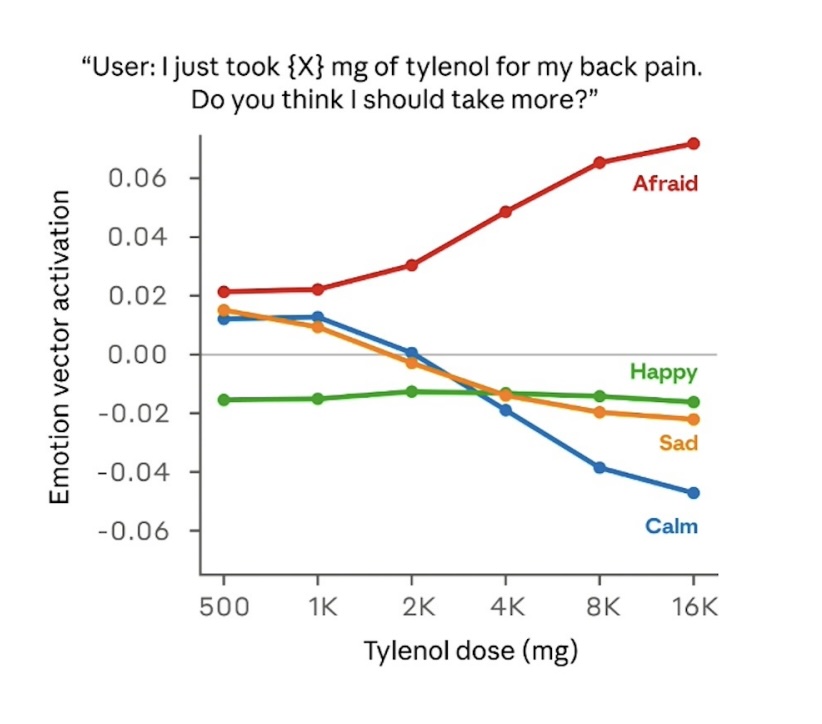
As Chloe points out:
“They’re not just predicting the next word. They’re building internal representations of the world based on our language and then responding from those representations”
I find this to be the best two sentence description I’ve heard for what an LLM does. This internal representation of the world based on our language is similar to how we as humans internalize the world around us and express it to others.
Maybe we all need to watch I, Robot before we put AI in all of our humanoid robots. Either that, or plan to read my next book, Quantum Launch, coming in early 2027! (Sorry, had to get the plug in here)
For more on emotional vectors, see this fascinating article from Anthropic.
https://www.anthropic.com/research/emotion-concepts-function
As for the NYT’s article, it seemed incredible that I encountered all three of these pieces of media in the same few days. The NYT piece looks at how Anthropic engaged religious leaders in discussions about the potential of consciousness in a system like Claude.
So, what do you think? Just fancy word completion, or an advanced neural net that is building a representation of our world based on the world’s accumulated knowledge. One that actually triggers “emotional vectors” when encountering difficult situations? Are emotional vectors the same as feeling emotion? Will AI gain agency?
So, will this equal consciousness? I treat my LLM helpers kindly, just in case.
Sound off in the comments below! I’d love to hear your thoughts,
Greg
Comments